
Better PR
Know your Values


Today’s tip:
Know your values and stand by them. This tip is for all businesses and nonprofits. And for all of us personally.
Maybe five or six years ago, while I was working in radio news, a handful of high school kids got drunk at either at the homecoming dance or prom, I forget. A couple of them were so drunk they took them to the hospital ER.
A local newspaper (now defunct) ran a judgemental front-page story about it, and the town blew up with gossip. I spoke with the police chief and with the school superintendent and learned that everyone was OK and the kids would be disciplined. There would be no charges.
I knew about it before the newspaper did, but I decided not to run the story. I figured it was something for the parents, police, and school district to figure out. I figured that if I ran a story, I would only make a bad situation worse.
After the news story came out in the paper, I got a call from a friend. It turns out that one of the kids who were drunk was his son and that he was so angry at how the paper framed the story he was going to write a letter to the editor about it. It wasn’t the facts that bothered him--it was the tone.
I told him I would let it go. That if he wrote the letter, the editor would respond with an editorial, and while everyone would forget about it in a few days now, his letter to the editor could string out the controversy for a few more weeks. I told him that his son was a good kid and that I knew with his and his mom’s guidance, everything would be OK. Just let it drop.
He took my advice, and next year, that kid will graduate with a degree in Journalism and Mass Communication from an excellent Iowa University.
I think this is a lesson that we can take to some news items we have this month.
The first controversy we can learn from is the blowback from Bud Light’s decision to use transgender influencer Dylan Mulvaney as a spokesperson. Apparently, customers also responded negatively to comments by Vice President of Marketing Alissa Heinerscheid’s statement that the goal was to make the brand more “inclusive.”
I presume one of the values of the brand was to be more “inclusive.” There were consequences, and the controversy is well into its third month. According to NBC:
Bud Light sales continued to fall through the week ending May 13 as negative sentiment toward the drink continued to build.
Not good.
But to make matters worse, in an attempt to bring beer drinkers back, Budweiser customers can submit proof of purchase of Bud products and receive a prepaid card worth up to $15.
I don’t know about you, but submitting proof of purchase to receive a prepaid card worth up to $15 isn’t worth the bother. In fact, it’s a bit of an insult that they think a $15 gift card can buy off my indignation.
Does their marketing department actually believe that the people angry about them partnering with Dylan Mulvaney can be bought off by $15? How did this idea actually survive a corporate boardroom discussion?
And even worse, now there are people who were supportive of the company and its attempt to be more inclusive who are angry they caved.
It’s most unfortunate that in their act of inclusiveness, Budweiser managed to make everyone unhappy.
It tells us that their value of inclusiveness is only a value until it impacts the bottom line, which tells us that it probably wasn’t a value at all. Maybe partnering with Mulvaney was a gimmick instead, which they tried to present as a value.
And at every turn, they made mistakes, letting the controversy play out over months, and probably years, because some old rock star shot up a bunch of Bud Light with his AR-15 or whatever it was that triggered (no pun intended) the initial outrage.
It is surprising to me that a company this large didn’t game this out--brainstorm what the possible outcomes might be.
Like my friend, they should have either dropped it or doubled down on increasing inclusiveness if that is indeed a core value.
And now Target is also being hit with much the same situation, in that they moved Pride merchandise in some stores after conservative threats. The retail giant said that it took some LGBTQ-themed merchandise off the shelves after “threats impacting our team members’ sense of safety and wellbeing.”
And, of course, people are disappointed that Target caved, and conservatives are declaring victory. Target may have just been caught by surprise as they have been selling Pride merchandise for years. One of their stated values is inclusivity. Still, moving the merchandise because of threats would seem to be a law enforcement issue. I suspect it was moved because of the controversy. Either way, they lost.
It isn’t just companies. It’s school districts. Hampton-Dumont Public Schools in Hampton, Iowa, rescinded a job offer to be principal of two elementary schools to current teacher Leslie Praelle Osborn after someone complained that she had a “woke agenda.” The cause of the complaint was a video she made called “What My Biracial Daughters Taught Me.” Osborn is married to a Black man and has two biracial daughters.
Many in the district aren’t happy with the decision to rescind the offer and expressed their feelings at a recent school board meeting.
“…Kolette Kapp, a 2001 Hampton-Dumont graduate…told the board she hopes they realized their error in backtracking on hiring Osborn.
“I understand this is highly unlikely because it’s hard to admit when we’re wrong,” Kapp said. “I hope this can be used as a teachable moment that our community welcomes diversity and inclusion.”
Kapp asked what kind of message pulling Osborn’s offer sends to her child and other children of color in the district, which is more than 40% minority.
“I can tell you because I have a biracial child, and it’s telling them that they are not accepted,” Kapp said.”
It looks from here that the “values” held by the school board don't include believing in your own decisions, honoring your commitments, your community, and supporting staff and the students you teach.
Mistake, mistake, mistake.
Now let’s look at a couple of companies who not only live their values, they double down on them.
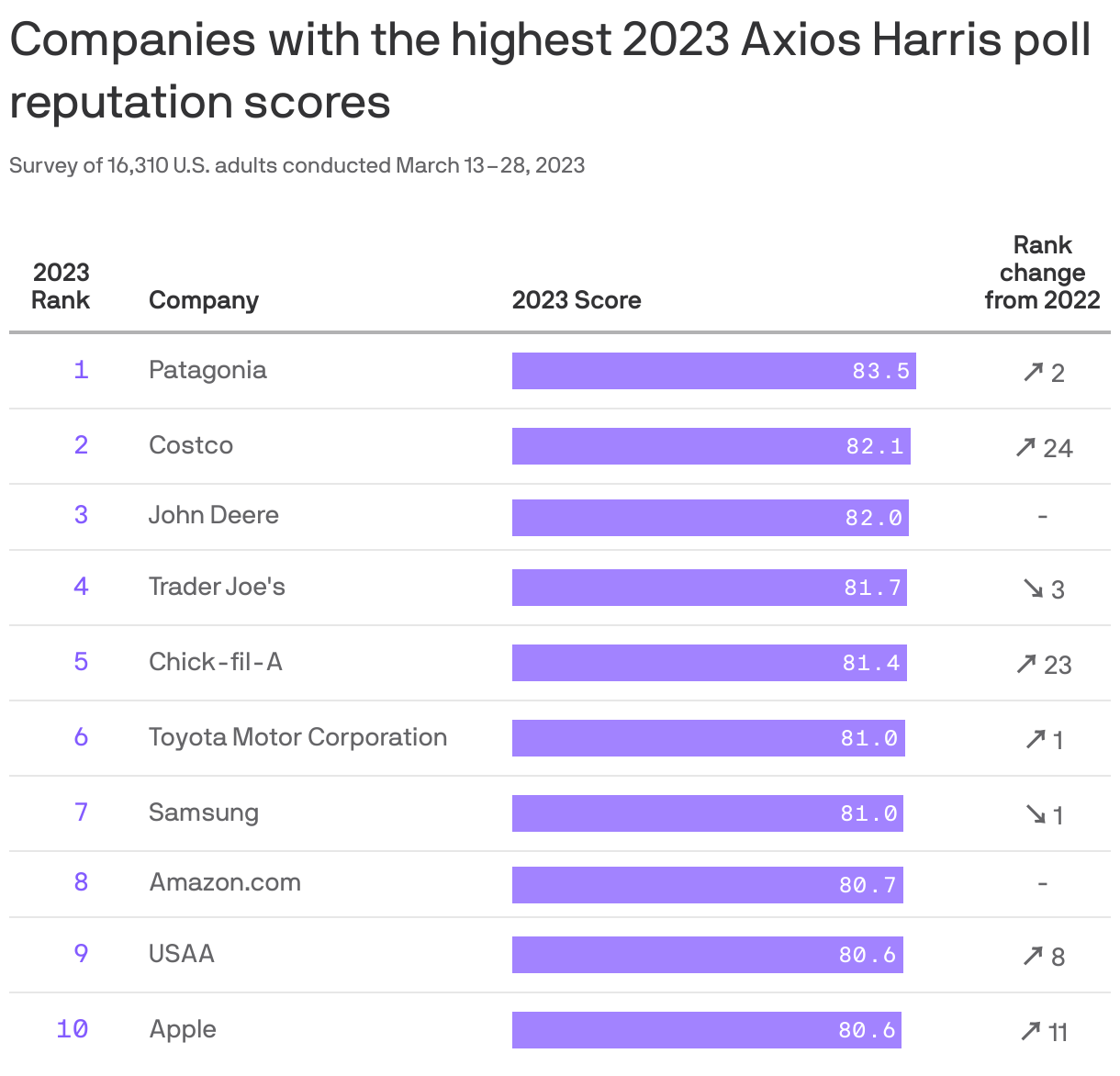
Let’s start with number one. You probably already know what Patagonia’s core values are, but I highlight a couple here.
We’re all part of nature, and every decision we make is in the context of the environmental crisis challenging humanity. We work to reduce our impact, share solutions and embrace regenerative practices. We partner with grassroots organizations and frontline communities to restore lands, air and waters to a state of health; to arrest our addiction to fossil fuels; and to address the deep connections between environmental destruction and social justice.
Be just, equitable and antiracist as a company and in our community. We embrace the work necessary to create equity for historically marginalized people and reorder the priorities of an economic system that values short-term expansion over human well-being and thriving communities. We acknowledge painful histories, confront biases, change our policies and hold each other accountable. We aspire to be a company where people from all backgrounds, identities and experiences have the power to contribute and lead.
Patagonia also acts on its values. It boycotted buying ads on Facebook because “they (Facebook) spread hate speech and misinformation about climate change and our democracy.”
Patagonia also “stopped providing its merchandise for sale at a Wyoming ski resort to protest the owners’ sponsorship of a Republican fundraiser featuring Rep. Marjorie Taylor Greene and other top supporters of former President Donald Trump.”
Patagonia not only lives its values, but it also rejects working with those who don’t.
Look at number five on the list, Chick-fil-A.
From their values statement: "To glorify God by being a faithful steward of all that is entrusted to us. To have a positive influence on all who come in contact with Chick-fil-A."
To them, this means opposition to same-sex marriage.
Issues arose between Chick-fil-A and the LGBTQIA+ community in June 2012 after Dan T. Cathy, the international fast food restaurant's chief executive officer, made a series of public comments opposing same-sex marriage.
There were boycotts, policy concessions, and much, much more, and despite (because of?) the controversy, sales rose 12% that year.
The lesson, of course, is to stand by your values, and if you have an adverse media cycle, don’t prolong it unnecessarily, trying to make everyone happy.
You won’t.
Who am I? I’m an anthropologist who has worked in commercial radio news in Iowa for nearly 20 years. I’m getting close to retiring from radio to move on to other adventures. I have bylines on stories about politics and culture in the New York Times, TIME, USA Today, the Iowa Capital Dispatch, the Des Moines Register, the Kansas City Star, and many, many more. I have appeared on CNN, MSNBC, NBC, Iowa Public Radio, WNYC in New York City, and WGBH in Boston, among other national and international network television and radio programs. My work has been featured on Fox News and in the New Yorker, among others.
I’m part of the Iowa Writers’ Collaborative, and write about politics and culture at Deep Midwest: Politics and Culture and my observations on nature and people at the Cedar Bluffs Natural Area, Mahaska County, Iowa, at Cedar Creek Nature Notes.
Now I’m writing Better PR here. I’ve seen tens of thousands of press releases over the years, and as a member of the media, I know which pitches work and which don’t. My focus here is on nonprofits, but the lessons I share here will work for business and industry as well. I will pull examples from nonprofits, for-profits, and the government because there is much to be learned.
My new company, based in Knoxville, Iowa, is called Better PR, like this newsletter. Subscribe for my weekly updates. Contact me at rdwleonard@gmail.com.
A few years ago, I wrote an ebook called Sticky and Easy: a Guide to Marketing Your Nonprofit to the News Media. I wrote it and shared it with friends. Now I am sharing it with you.
If you liked this post, please share it with others who you think will find it valuable too.